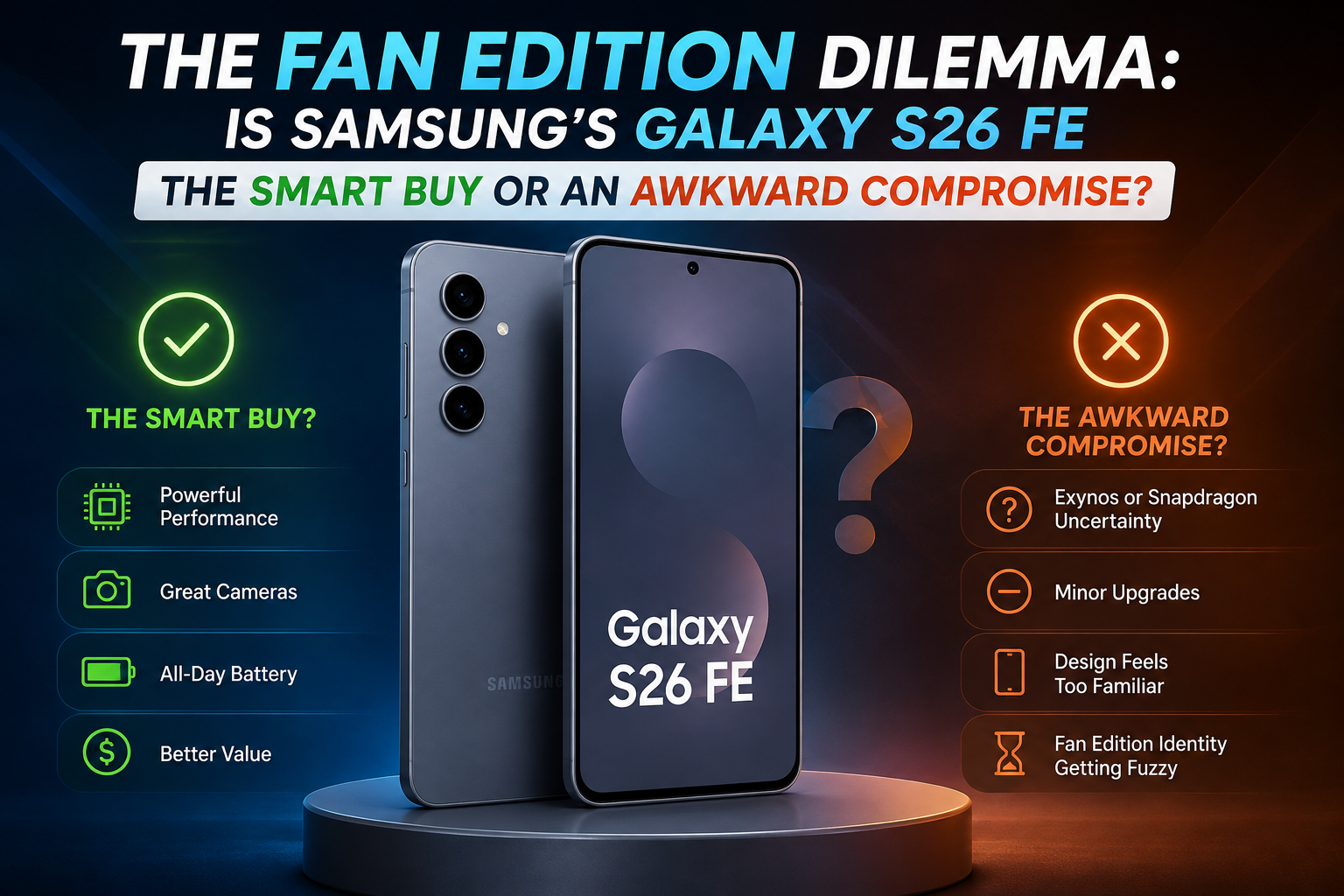
Samsung has officially pulled the curtain back on the Galaxy S26 FE, the newest member of its Fan Edition lineup designed to bring flagship-grade hardware and software down to a more palatable price point. Unveiled on August 27, 2026, the device arrives in a smartphone landscape squeezed by industry-wide component costs. While it brings meaningful upgrades—including a 3nm processor, expanded video tracking tools, and a surprising long-term software edge over its flagship siblings—it also lands with a price hike that forces buyers to weigh their options carefully.
A Glossier Look with Flagship-Grade Durability
In the hand, the Galaxy S26 FE immediately stands apart from last year’s Galaxy S25 FE. Samsung has abandoned the matte back of its predecessor in favor of a reflective, glossy glass finish, framed by aluminum and shielded front and back by Corning Gorilla Glass Victus+. While the reflective back looks striking in its three colorways—Blueberry, Graphite, and Pistachio—it does attract visible fingerprint smudges, especially on the darker variants.
The phone measures 161.6 x 76.9 x 7.4 mm and weighs 193 grams (6.81 ounces). Although it is a hair heavier than the 6.70-ounce S25 FE, it retains essentially the same profile and feels balanced in daily handling. Crucially, Samsung kept full IP68 dust and water resistance, ensuring it can survive fresh water submersion up to 1.5 meters for 30 minutes.
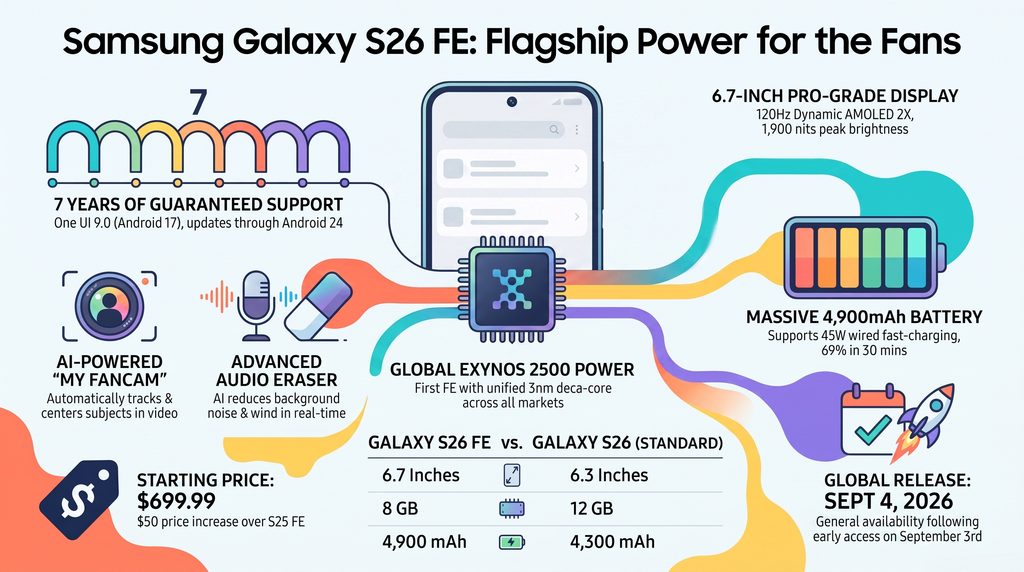
Up front sits a large 6.7-inch Dynamic AMOLED 2X display running at FHD+ resolution (2340 x 1080 pixels) with a fluid 120Hz refresh rate and HDR10+ support. The panel reaches a peak brightness of 1,900 nits. While vibrant and sharp for streaming and gaming, it does stop short of the 2,600-nit outdoor peak offered by the higher-end Galaxy S26.
Exynos 2500 Goes Global: What’s Under the Hood
For years, buying a Fan Edition phone meant navigating a regional lottery between Qualcomm Snapdragon and Samsung Exynos processors. This time, Samsung eliminates the guesswork: the Galaxy S26 FE runs on the Exynos 2500 worldwide.
Fabricated on Samsung’s 3nm GAA architecture, the Exynos 2500 features a 10-core CPU cluster led by a Cortex-X925 core clocking up to 3.3GHz, paired with an Xclipse 950 GPU based on AMD’s RDNA 3 architecture. Its dedicated NPU delivers up to 59 TOPS of AI compute, powering on-device intelligence. Interestingly, regulatory teardowns reveal a hybrid engineering choice: while Samsung’s System LSI provides the core processing and cellular modem, the phone incorporates Qualcomm FastConnect hardware to drive Wi-Fi 6E and Bluetooth 5.4 connectivity.
All storage configurations are paired with 8GB of RAM. Buyers can choose between 128GB, 256GB, and 512GB of UFS 4.0 storage, though the top 512GB tier is reserved for select markets like the UK and Europe and will not be offered in the US. As with previous generations, there is no expandable microSD card slot.
Camera Hardware and Clever Software Tricks
Rather than overhauling the camera sensors, Samsung focused its attention on computational photography and video stabilization. The rear triple-camera array consists of:
- 50MP main sensor (f/1.8, 24mm, 1/1.57″, dual-pixel PDAF, OIS)
- 12MP ultra-wide camera (f/2.2, 123-degree field of view)
- 8MP telephoto lens (f/2.4, 75mm, PDAF, OIS) offering 3x optical zoom and up to 30x digital zoom
Selfie duties are handled by an upgraded 12MP front-facing sensor designed with wider framing for group shots.
On the software side, Samsung ported several camera tools that debuted on its premium foldables and flagships. My FanCam dynamically detects and tracks a chosen subject in video recording to keep them centered. Super Steady with Horizontal Lock keeps recorded footage upright and level even through a full 360-degree rotation of the phone. Users also get Audio Eraser, which selectively suppresses ambient background noise such as city traffic and wind while keeping voices clear, alongside natural-language Photo Assist for object removal and image touch-ups.
Battery Life and Fast 45W Charging
Battery endurance has always been a pillar of the FE experience, and the S26 FE packs a 4,900mAh battery. Unlike the base Galaxy S26, which is restricted to 25W charging, the FE supports 45W wired fast charging, enabling it to replenish from flat to 69% in approximately 30 minutes with a compatible adapter.
Convenience features remain intact: the device supports 15W wireless charging (Qi2 compatible) as well as Wireless PowerShare (reverse wireless charging) for juicing up Galaxy Buds or smartwatches on the go.
The Surprise Advantage: One UI 9 and 7 Years of Updates
Perhaps the most compelling aspect of the Galaxy S26 FE is its launch timing. Because it arrives later in the calendar year, the S26 FE ships with Android 17 and One UI 9.0 out of the box, becoming the first device in the S26 family to do so.
Samsung guarantees seven major Android OS upgrades and seven full years of security patches. Because software support is calculated from the version a device ships with, the Galaxy S26 FE is slated to receive updates all the way through Android 24. By contrast, the standard Galaxy S26, S26+, and S26 Ultra launched earlier in the year on Android 16 (One UI 8.5) and will cap out at Android 23. This hands the more affordable Fan Edition a full extra year of operating system support compared to the premium flagships that preceded it.
The One UI 9 experience also brings expanded Galaxy AI tools, including Now Brief for natural-language schedule and wellness cards, contextual Now Nudge notifications, and enhanced multi-item queries via Circle to Search with Google.
Galaxy S26 FE vs. Galaxy S26: The Core Differences
To see where the S26 FE lands against the standard Galaxy S26, the key hardware differences break down as follows:
| Feature | Galaxy S26 FE | Galaxy S26 (Flagship) |
| Display | 6.7-inch Dynamic AMOLED 2X, 1,900 nits | 6.3-inch Dynamic AMOLED 2X, 2,600 nits |
| Processor | Exynos 2500 (Global) | Snapdragon 8 Elite Gen 5 / Exynos 2600 |
| RAM | 8GB | 12GB |
| Telephoto Camera | 8MP (3x optical) | 10MP (3x optical) |
| Battery & Charging | 4,900mAh, 45W wired, 15W wireless | 4,300mAh, 25W wired, 15W wireless |
| Weight | 193g | 167g |
| OS at Launch | Android 17 (One UI 9.0) | Android 16 (One UI 8.5) |
| Software Ceiling | Supported through Android 24 | Supported through Android 23 |
If you prioritize a larger viewing area, bigger battery capacity, faster wired top-ups, and an extra year of software lifecycle, the S26 FE holds a clear upper hand. Conversely, those wanting a compact one-handed footprint, higher RAM headroom for multitasking, a brighter outdoor screen, and top-tier silicon performance are better served by the standard S26.
Pricing, Release Date, and Verdict
The Galaxy S26 FE launches globally on September 4, 2026, with select carriers in the United States offering early access on September 3. In India, sales kick off on September 18.
Official pricing reflects an across-the-board increase over last year’s model:
- 8GB + 128GB: $699.99 / £699 / €799 (up $50 / €50 from the S25 FE’s launch price)
- 8GB + 256GB: $799.99 / £799 / €899
- 8GB + 512GB: £949 / €1,099 (not offered in the US)
At $699.99, the Galaxy S26 FE is $200 cheaper than the entry-level Galaxy S26 ($899.99). However, starting at 128GB of storage and 8GB of RAM in 2026 makes the base tier feel a bit tight for heavy users. Upgrading to the recommended 256GB model pushes the price to $799.99—narrowing the gap to the flagship, particularly when promotional carrier discounts on the older S26 come into play.
Nonetheless, for shoppers seeking a large, bright screen, strong battery life, rapid 45W charging, and guaranteed software support deep into the next decade, the Galaxy S26 FE packages the best of Samsung’s flagship DNA into a much more accessible device.
📱 We could put together a detailed comparison table matching the S26 FE against the previous S25 FE and S24 FE to see how the series has evolved over the last three generations.