
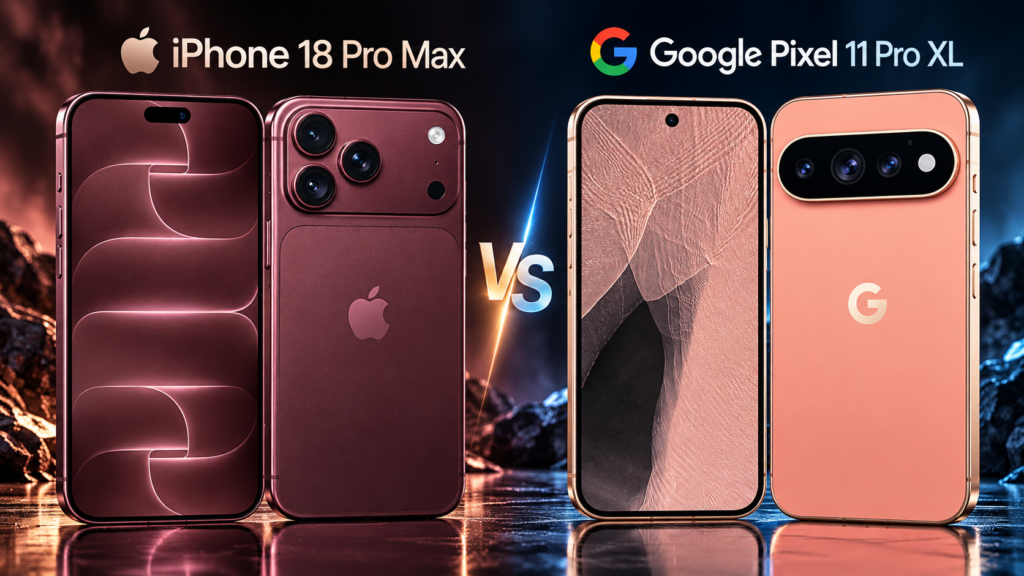
iPhone 18 Pro Max vs Google Pixel 11 Pro XL: Which Phone Is Better in 2026?
Choosing between Apple’s latest premium iPhone and Google’s flagship Android phone is not an easy decision. Both offer impressive displays, advanced cameras, powerful processors, and smart software features. However, the biggest question remains: iPhone 18 Pro Max vs Google Pixel 11 Pro XL — which phone is better in 2026?
Apple’s iPhone 18 Pro Max focuses on performance, video recording, battery life, and the familiar iOS experience. The Google Pixel 11 Pro XL takes a different approach, combining Google’s AI features, computational photography, Android flexibility, and a bright, high-resolution display.
Both smartphones are designed for people who want more than the basics from their phones. Whether you create content, take photos while traveling, play demanding games, or simply want a reliable premium device, your choice depends on which features matter most in everyday use.
In this detailed comparison, we will examine the iPhone 18 Pro Max and Google Pixel 11 Pro XL across design, display, camera quality, performance, battery life, software, AI features, and price. By the end, you should have a clearer idea of which flagship smartphone deserves your money in 2026.
iPhone 18 Pro Max vs Google Pixel 11 Pro XL: Quick Comparison
Before looking at the details, here is a quick overview of the main differences between these two flagship smartphones.
| Feature | iPhone 18 Pro Max | Google Pixel 11 Pro XL |
|---|---|---|
| Operating system | iOS 27 | Android 17 |
| Display size | 6.9-inch OLED | 6.8-inch LTPO OLED |
| Refresh rate | Up to 120Hz | Up to 120Hz |
| Processor | Apple A20 Pro | Google Tensor G6 |
| Main camera | 48MP with variable aperture | 50MP main camera |
| Ultrawide camera | 48MP | 48MP |
| Telephoto camera | 48MP Pro Fusion system | 48MP telephoto |
| Front camera | 18MP Center Stage | 42MP |
| Battery | Large-capacity battery; varies by model | 5,115mAh typical capacity |
| Wired charging | Up to 60W | Up to 45W |
| Wireless charging | Up to 25W MagSafe/Qi2 | Up to 25W Qi2.2 |
| Starting storage | 256GB | 256GB |
| Starting US price | $1,299 | $1,099 list price |
Specifications and pricing are based on published manufacturer information and reported device specifications. Charging performance, battery capacity, and available configurations can vary by market. Retail prices and promotions may change.
The comparison reveals two different priorities. Apple emphasizes processing power, creative controls, and video capabilities, while Google combines a high-brightness display with Android software and AI-assisted photography.
1. Design and Build Quality: Apple vs Google
The iPhone 18 Pro Max and Pixel 11 Pro XL both have the premium construction expected from flagship smartphones, but they have different design identities.
iPhone 18 Pro Max design
Apple continues its familiar flat-edged iPhone design with a large display, refined camera hardware, and a premium aluminum body. The smaller Dynamic Island gives the front a cleaner appearance without completely changing the look of the iPhone.
The device is available in several finishes, including burgundy, glacier, silver, and black. Its large size makes it suitable for watching videos, editing photos, and working on the go, although people with smaller hands may find one-handed use difficult.
Apple’s design approach is relatively conservative. Rather than reinventing the iPhone, the company has concentrated on improving the camera system, internal hardware, and battery performance.
Google Pixel 11 Pro XL design
Google’s Pixel 11 Pro XL maintains the distinctive Pixel design language, including its recognizable rear camera bar. Its large display and premium finish give it a modern appearance, while the front remains focused on screen space.
Google also offers a different approach to everyday interaction. The in-display fingerprint reader provides an alternative to Apple’s Face ID, and Android gives users more freedom to customize their home screens, widgets, and default applications.
The Pixel is still a large phone, weighing approximately 226 grams. Anyone who prefers a lightweight, compact device should consider its size before buying.
Which phone has the better design?
The iPhone 18 Pro Max is a strong choice for buyers who appreciate Apple’s consistent design, integrated hardware, and polished finish. The Pixel 11 Pro XL is better suited to people who prefer Google’s visual style and the flexibility of Android.
Neither phone is an obvious winner for everyone. Comfort, grip, case selection, and personal preference matter more than small differences in appearance.
2. Display Comparison: Which Phone Has the Better Screen?
A flagship smartphone should offer a screen that looks good in direct sunlight, displays colors accurately, and makes everyday activities enjoyable. Both phones deliver high-end display technology, but their specifications are slightly different.
iPhone 18 Pro Max display
The iPhone 18 Pro Max features a 6.9-inch Super Retina XDR OLED display with a resolution of 2868 × 1320 pixels and a refresh rate of up to 120Hz.
Apple’s ProMotion technology adjusts the refresh rate according to what is happening on the screen. Scrolling through websites, navigating menus, and playing supported games can feel smooth, while adaptive refresh rates can help manage power consumption.
The display also supports HDR, an always-on mode, and high outdoor brightness. These features make the phone suitable for streaming movies, browsing photos, and using demanding creative applications.
Google Pixel 11 Pro XL display
Google equips the Pixel 11 Pro XL with a 6.8-inch Super Actua LTPO OLED display. It has a resolution of 1344 × 2992 pixels, a pixel density of 486 pixels per inch, and a refresh rate ranging from 1Hz to 120Hz.
One of its biggest advantages is its advertised peak brightness of up to 3,600 nits, with HDR brightness rated at up to 2,400 nits. These figures make the Pixel particularly appealing to people who frequently use their phones outdoors.
However, peak brightness figures are not directly comparable to every other manufacturer’s measurements. Actual visibility depends on screen content, ambient light, and how long the display sustains its brightness.
Display verdict
The Pixel 11 Pro XL has an impressive brightness specification, making it worth considering if you spend a lot of time outside. The iPhone 18 Pro Max offers a slightly larger screen and Apple’s familiar color presentation.
For watching movies, reading articles, and using social media, both are excellent. Most people will notice the size and brightness more readily than the difference in resolution.
3. Camera Comparison: iPhone 18 Pro Max vs Pixel 11 Pro XL
Camera quality is one of the most important reasons people buy expensive smartphones. Both Apple and Google have spent years improving mobile photography, but they approach image processing differently.
Apple places considerable emphasis on consistent colors, video recording, and creative controls. Google focuses heavily on computational photography, automatic image processing, and software-assisted editing.
iPhone 18 Pro Max camera
The iPhone 18 Pro Max introduces a 48MP Fusion main camera with a variable aperture. This allows the main camera to adjust its aperture between supported settings, giving photographers more control over how much light enters the lens and how images are captured.
The rear camera system also includes a 48MP ultrawide camera and additional telephoto capabilities within Apple’s Pro Fusion system.
For everyday photography, this setup is designed to handle portraits, landscapes, street photography, food, and low-light scenes. Apple’s image processing aims for consistent results, while its camera controls offer more options for people who like to adjust their shots.
Video is another major strength. The phone supports advanced recording features, including 4K Dolby Vision recording and professional video formats in supported configurations. These capabilities are especially useful for creators who edit footage after recording.
If you regularly record YouTube videos, product demonstrations, travel clips, or social media content, the iPhone should be high on your list.
Google Pixel 11 Pro XL camera
The Pixel 11 Pro XL features a 50MP main camera, a 48MP ultrawide camera, and a 48MP telephoto camera. Google combines its camera hardware with computational photography to improve exposure, detail, and image processing.
Pixel phones have built a strong reputation for producing attractive photographs with relatively little effort. Google’s approach is particularly appealing to people who want to point the camera at a subject, take a picture, and get a polished result without adjusting numerous settings.
The telephoto camera is useful for photographing distant subjects, while the ultrawide lens helps capture landscapes, architecture, and group photos.
Google’s AI-assisted editing tools can also help users make adjustments after taking a picture. Depending on the feature, these tools can make it easier to refine an image without using a separate editing application.
The 42MP front camera is another specification worth noting for selfies and video calls, although megapixels alone do not determine image quality.
Which phone takes better photos?
The answer depends on the type of photography you enjoy.
The Pixel 11 Pro XL is a compelling option for casual photographers who value convenient image processing, flexible zoom photography, and software-assisted editing. The iPhone 18 Pro Max is particularly attractive to people who want detailed camera controls and a versatile video recording system.
It would be misleading to declare one phone the universal camera winner based on megapixels alone. Lens quality, sensor size, stabilization, exposure, skin tones, and image processing all influence the final result.
For the most accurate comparison, look for side-by-side photos taken in daylight, indoors, at night, and at the same zoom levels. Video stabilization, autofocus, audio quality, and exposure consistency should also be considered.
Camera winner: Choose the iPhone 18 Pro Max if video production is your priority. Consider the Pixel 11 Pro XL if you prefer Google’s photography tools and AI-assisted image editing.
4. Performance: A20 Pro vs Google Tensor G6
Performance affects almost everything you do on a smartphone, from opening applications to editing video and playing games.
Apple’s A20 Pro and Google’s Tensor G6 are designed with different priorities, so benchmark scores alone cannot tell the complete story.
iPhone 18 Pro Max performance
The A20 Pro powers Apple’s latest Pro iPhone and is designed to deliver high processing performance while managing power consumption. Apple also uses a next-generation vapor chamber to support sustained performance during demanding workloads.
For everyday users, this means the iPhone is built to handle multitasking, high-resolution video editing, demanding games, and intensive applications.
The combination of Apple’s processor and iOS also gives developers a consistent hardware and software environment to optimize their applications.
For people who use resource-intensive creative apps or want strong gaming performance, the iPhone 18 Pro Max is an appealing option.
Google Pixel 11 Pro XL performance
Google’s Tensor G6 powers the Pixel 11 Pro XL and supports the company’s approach to AI features, image processing, and Android software.
Tensor chips are particularly relevant to Google’s strategy because many Pixel features rely on a combination of local processing and cloud-based services. This can help with tasks such as photo editing, voice-related features, and other intelligent software functions.
For everyday activities such as browsing, messaging, navigation, photography, and multitasking, the Pixel offers a premium experience.
However, users who prioritize demanding games, specialized professional applications, or sustained high-performance workloads should compare independent benchmark tests and real-world performance reviews before deciding.
Performance verdict
The iPhone 18 Pro Max is the stronger starting point for buyers who prioritize raw processing power, intensive gaming, and creative workloads. The Pixel 11 Pro XL makes a persuasive case for users who value Google’s software features and AI-focused experience.
For everyday use, both phones are capable flagship devices. The practical difference depends on your applications and how heavily you use them.
5. Battery Life and Charging: Which Phone Lasts Longer?
Battery life can make or break the smartphone experience. A powerful phone is less useful if it needs to be charged halfway through the day.
iPhone 18 Pro Max battery life
Apple highlights battery life as one of the major improvements in the iPhone 18 Pro Max. Its combination of a larger battery, A20 Pro processor, and hardware-software optimization is designed to support longer use between charges.
Apple rates the iPhone 18 Pro Max for up to 29 hours of video playback. This is a manufacturer estimate under controlled conditions, not a guarantee of the same result during gaming, navigation, mobile data use, or video recording.
The phone supports MagSafe and Qi2 wireless charging at up to 25W, while wired charging is advertised at up to 60W under supported conditions.
For travelers, creators, and people who use their phones heavily throughout the day, these improvements are important.
Google Pixel 11 Pro XL battery life
The Pixel 11 Pro XL has a typical battery capacity of 5,115mAh. Google advertises more than 30 hours of battery life, although actual results depend on usage and settings.
The phone supports wired charging at up to 45W with a compatible USB-C PPS charger. Google also supports Qi2.2-certified wireless charging at up to 25W.
The larger battery capacity does not automatically mean the Pixel will last longer than the iPhone. Battery performance also depends on display brightness, processor efficiency, mobile signal strength, background activity, and software optimization.
Which phone has better battery life?
Both phones are designed for all-day use, but real-world testing is needed to establish which lasts longer under identical conditions.
The iPhone’s published video-playback rating and improved battery design make it an attractive option for heavy users. The Pixel’s 5,115mAh battery and fast wired charging also make it competitive.
If battery life is your top priority, compare independent tests that use the same brightness level, network conditions, applications, and workload. Those results are more useful than battery capacity alone.
6. Software and AI Features: iOS 27 vs Android 17
Software is one of the biggest differences between these phones. Your choice affects not only how the interface looks but also how you manage files, customize the home screen, share content, and interact with other devices.
iPhone 18 Pro Max and iOS 27
The iPhone 18 Pro Max runs iOS 27 and includes Apple’s latest Apple Intelligence and Siri AI capabilities.
Apple’s approach emphasizes integration across the operating system and supported applications. Features such as intelligent assistance, photo tools, and system-level improvements are designed to work within Apple’s broader ecosystem.
The iPhone is particularly convenient for people who already own a Mac, iPad, Apple Watch, or AirPods. Features such as AirDrop, device synchronization, and continuity tools can make switching between devices easier.
The trade-off is that iOS offers less freedom in certain areas than Android. Users who want extensive interface customization, more control over default applications, or different file-management workflows may prefer Google’s platform.
Google Pixel 11 Pro XL and Android 17
The Pixel 11 Pro XL runs Android 17 and offers Google’s software experience, including integrated Google services and Pixel-specific features.
Android provides more flexibility in how users organize their home screens, choose default apps, manage files, and personalize the interface.
Google also places considerable emphasis on AI. Pixel features can help with photography, voice interactions, and other daily tasks. Availability and functionality may depend on region, language, account settings, internet access, and software updates.
Google lists support for up to seven operating system updates for the Pixel 11 Pro XL. This is a significant benefit for buyers who want to keep their phones for several years.
Which software experience is better?
Choose iOS if you prefer Apple’s ecosystem, a consistent interface, and close integration with other Apple devices.
Choose Android if you value customization, Google services, and greater flexibility in how you use your phone.
Neither operating system is universally better. The right choice is the one that fits your habits, preferred applications, and existing devices.
7. Price and Value for Money
A flagship phone should justify its price through features that you will actually use. The most expensive option is not necessarily the best value.
iPhone 18 Pro Max price
Apple announced the iPhone 18 Pro Max with a starting US price of $1,299 for the 256GB model.
That places it firmly in the premium smartphone category. The cost may be easier to justify for users who need its video features, high performance, large display, and Apple ecosystem integration.
However, if you mainly use your phone for messaging, social media, browsing, and casual photography, you may not benefit from every premium feature.
Google Pixel 11 Pro XL price
The Pixel 11 Pro XL has a published US list price of $1,099 for its base configuration, although discounts and trade-in offers can reduce the price.
That makes the Pixel less expensive at list price than the iPhone 18 Pro Max. The difference may be meaningful for buyers who want a large premium display, a versatile camera system, and Google’s Android experience without spending as much.
Remember that advertised discounts can vary by retailer, storage capacity, and eligibility. Always compare the actual checkout price rather than relying on a promotional headline.
Which phone offers better value?
The Pixel 11 Pro XL is the more affordable starting point based on the listed US prices. The iPhone 18 Pro Max may justify its premium for buyers who will make use of its video capabilities, processing power, and Apple ecosystem.
Before buying, compare storage options, trade-in values, warranty coverage, repair costs, and local network compatibility. These factors can have a noticeable impact on the total cost of ownership.
8. iPhone 18 Pro Max vs Pixel 11 Pro XL: Pros and Cons
iPhone 18 Pro Max pros
- Powerful A20 Pro processor for demanding applications and gaming.
- Advanced 48MP camera system with variable aperture on the main camera.
- Strong video recording capabilities for creators.
- Large 6.9-inch OLED display with adaptive refresh rates up to 120Hz.
- Deep integration with Apple devices and services.
- Improved battery-life claims compared with previous generations.
iPhone 18 Pro Max cons
- Higher starting price than the Pixel 11 Pro XL.
- Large size may not suit everyone.
- iOS offers less customization than Android in some areas.
- Some advanced camera and video features may be unnecessary for casual users.
Google Pixel 11 Pro XL pros
- Lower starting US list price than the iPhone 18 Pro Max.
- Bright 6.8-inch LTPO OLED display with a claimed peak brightness of up to 3,600 nits.
- Versatile 50MP main, 48MP ultrawide, and 48MP telephoto cameras.
- Google AI features and computational photography tools.
- Android customization and Google services integration.
- Up to seven operating system updates listed by Google.
Google Pixel 11 Pro XL cons
- Large body may be uncomfortable for some users.
- Tensor G6 performance should be evaluated against demanding gaming and professional workloads.
- Some AI features may be limited by language, location, or internet availability.
- Actual battery endurance depends on usage and should be judged through independent testing.
9. Which Phone Should You Buy in 2026?
The best smartphone is not necessarily the one with the longest specification sheet. It is the one that makes your daily activities easier and provides the features you genuinely need.
Here is how I would approach the buying decision.
Buy the iPhone 18 Pro Max if…
You should consider the iPhone 18 Pro Max if you:
- Record a lot of videos for YouTube, TikTok, Instagram, or other platforms.
- Want a powerful processor for demanding games and creative applications.
- Already use a Mac, iPad, Apple Watch, or other Apple products.
- Prefer iOS and Apple’s integrated software experience.
- Want advanced camera controls and professional video formats.
For content creators in particular, the iPhone’s video capabilities may be more important than small differences in camera specifications.
Buy the Google Pixel 11 Pro XL if…
The Pixel 11 Pro XL may be the better fit if you:
- Prefer Android over iOS.
- Want Google’s photography and AI-assisted editing features.
- Value a bright display for outdoor use.
- Prefer more freedom to customize your phone.
- Want a premium large-screen smartphone with a lower starting list price.
- Plan to keep your phone for years and value Google’s stated update commitment.
For everyday photography and users who enjoy Google’s software, the Pixel offers a compelling alternative to Apple’s flagship.
Which phone is better for gaming?
The iPhone 18 Pro Max is the more compelling choice to start with if gaming performance is your priority, thanks to Apple’s A20 Pro hardware. However, check independent tests of the specific games you play, because optimization, thermal behavior, and frame-rate limits also matter.
Which phone is better for photography?
Both phones have capable multi-camera systems. The Pixel is attractive for Google’s image processing and editing tools, while the iPhone offers advanced camera controls and a strong video feature set.
Compare real-world samples before making a final decision, particularly for low-light photography, portraits, zoom, and skin tones.
Which phone is better for battery life?
Both manufacturers advertise long battery life, but their estimates use different testing methods. Look for independent side-by-side battery tests before choosing a winner.
Which phone is better for long-term use?
Both are premium devices with modern hardware and software support. Google lists up to seven operating system updates for the Pixel 11 Pro XL. For the iPhone, consider Apple’s ongoing software support, battery replacement options, repairability, and the condition in which you expect to keep the phone.
Final Verdict: iPhone 18 Pro Max vs Google Pixel 11 Pro XL
So, which phone is better in 2026?
The iPhone 18 Pro Max is my pick for users who prioritize video recording, powerful performance, and the Apple ecosystem. The Google Pixel 11 Pro XL is an excellent alternative for people who prefer Android, Google’s camera software, a very bright display, and a lower starting price.
The iPhone’s strengths make it especially attractive to video creators, gamers, and people who already use Apple devices. The Pixel makes more sense for buyers who enjoy Android customization and want Google’s AI-focused software experience.
There is no single winner for every type of user. If your priority is video and performance, lean toward the iPhone. If your priority is photography tools, Android flexibility, and value at the listed US prices, give the Pixel serious consideration.
Before spending your money, compare real-world camera samples, battery tests, current retailer prices, and the availability of features in your country. Those practical details will tell you more than a specification sheet alone.
Ultimately, the better phone is the one that fits your lifestyle, your budget, and the way you use your smartphone every day.
Frequently Asked Questions (FAQs)
Is the iPhone 18 Pro Max better than the Google Pixel 11 Pro XL?
The iPhone 18 Pro Max is a strong choice for performance, video recording, and Apple ecosystem integration. The Pixel 11 Pro XL is appealing for Android flexibility, Google’s camera tools, and its bright display. The better option depends on your priorities.
Is the Google Pixel 11 Pro XL cheaper than the iPhone 18 Pro Max?
Yes, based on their published US starting list prices. The Pixel 11 Pro XL starts at $1,099, while the iPhone 18 Pro Max starts at $1,299. Retail promotions and trade-in offers can change the final price.
Which phone has the better camera in 2026?
Both have advanced camera hardware. The iPhone is particularly attractive for video recording and creative controls, while the Pixel offers Google’s computational photography and AI-assisted editing. Real-world samples are the best way to judge image quality.
Which phone has the better display?
Both feature high-quality OLED displays with refresh rates up to 120Hz. The iPhone 18 Pro Max has a 6.9-inch screen, while the Pixel 11 Pro XL has a 6.8-inch display with a higher advertised peak brightness. Your preference will depend on screen size, brightness, and color presentation.
Is the Pixel 11 Pro XL good for gaming?
The Pixel 11 Pro XL is a premium smartphone capable of running demanding applications, but buyers focused on high-end gaming should check independent performance and thermal tests for their favorite titles.
Should I switch from iPhone to Google Pixel?
Switching makes sense if you prefer Android, want Google’s software features, or value more customization. Before switching, consider how you will transfer photos, messages, passwords, subscriptions, and other data, especially if you rely on Apple-specific services.
Which phone should I buy for YouTube content creation?
The iPhone 18 Pro Max is a strong choice for creators who prioritize video recording, stabilization, and professional editing workflows. The Pixel 11 Pro XL remains a capable alternative, especially for creators who prefer Android and Google’s image-processing tools.
Is the Google Pixel 11 Pro XL worth buying in 2026?
It is worth considering if you want a premium Android phone with a bright display, a versatile camera system, AI features, and long-term software support. Compare its current price with competing flagships before making a decision.