
The American wireless industry has entered an era of sharp friction between subscriber expectations and carrier economics. For years, mobile connectivity was pitched as an increasingly seamless utility: networks were getting faster, physical plastic SIM cards were giving way to instant software-provisioned eSIMs, and competitive pressures promised greater flexibility.
Instead, American smartphone owners find themselves caught in an aggressive cycle of stealth rate hikes, restructured “legacy” plan penalties, and persistent device locking policies. Rather than delivering a frictionless digital marketplace, major carriers—primarily AT&T, Verizon, and T-Mobile—are drawing severe public and regulatory backlash over upgraded pricing models and technical barriers that keep customers tethered to their networks.
The Anatomy of the Stealth Price Hike
For over a decade, consumer pricing in the telecom sector followed a predictable formula: trade-in credits subsidized flagship devices, and tiered unlimited plans offered predictable monthly costs. Recently, that playbook changed.
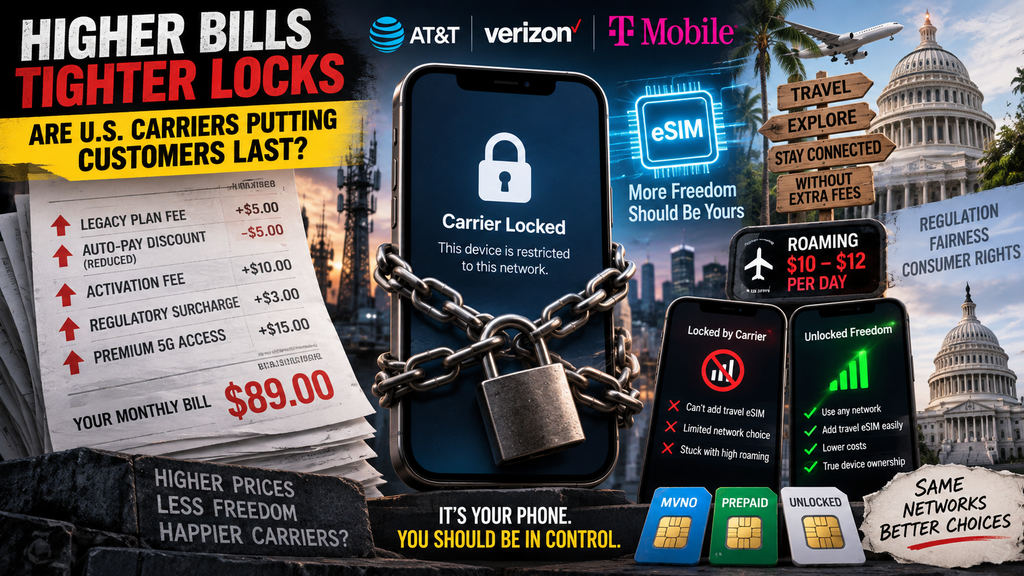
Rather than announcing sweeping, across-the-board base price increases that trigger headline alarm, major networks have pivoted to incremental, structural fee adjustments:
- Targeting Legacy Plans: Carriers have instituted monthly administrative charges or flat rate adjustments on older grandfathered plans. The underlying message to users is clear: pay more to stay where you are, or move to newer, more expensive plan tiers.
- Depreciating Auto-Pay Perks: Standard discounts for automatic billing have been quietly halved or restricted unless customers abandon credit cards in favor of direct debit or carrier-branded banking instruments.
- Activation and Administrative Surcharges: Standard device connectivity charges, upgrade fees, and regulatory recovery lines continue to climb, adding substantial out-of-pocket costs at checkout.
- Tier Stratification: High-speed hotspot data, premium 5G ultra-wideband access, and unthrottled streaming have been increasingly carved out of entry-level and mid-range tiers, forcing users who want original performance levels into top-bracket plans costing upwards of $85 to $90 per month for a single line.
Carriers justify these moves by pointing to capital expenditures, sustained inflation, and massive investments required to deploy 5G and fiber backhaul. But to the consumer, the calculus feels less like infrastructure support and more like margin extraction from an entrenched customer base.
The eSIM Promise vs. Carrier Reality
When Apple and other hardware manufacturers moved aggressively toward eSIM adoption—notably eliminating the physical SIM tray from domestic iPhone models starting with the iPhone 14—the shift was heralded as a breakthrough for user autonomy.
On paper, eSIM is liberating. Switching providers no longer requires waiting for a piece of plastic in the mail or visiting a retail store. In theory, international travel should be as simple as scanning a QR code to download a cheap local data profile while leaving your primary number active.
In practice, the carrier ecosystem quickly adapted to preserve its walled garden:
Carrier Locking of Subsidized Devices
When consumers purchase an eSIM-only phone on an installment plan or promotional 36-month trade-in schedule, the carrier software-locks the device. Because modern phones share dual-eSIM functionality, a carrier lock doesn’t just block the user from porting their primary number out; in many instances, it completely prevents the user from installing secondary, local travel eSIMs while abroad.
Roaming Gouging
By locking down the device’s eSIM slots, carriers ensure that traveling subscribers remain dependent on expensive daily roaming add-ons—typically $10 to $12 a day—instead of utilizing low-cost regional travel profiles that cost a fraction of that amount.
Artificial Switching Friction
Transferring an eSIM profile from one handset to another should take seconds. Yet subscribers frequently encounter backend errors, forced customer service interactions, and security delays. What was engineered as an open digital standard has been wrapped in carrier-specific operational red tape.
The Regulatory Clash
This combination of price pressure and digital lock-in has caught the attention of federal regulators. The Federal Communications Commission (FCC) has faced ongoing debates regarding mandatory device unlocking rules.Consumer advocates, led by groups like Public Knowledge and iFixit, have urged regulators to establish uniform, 60-day automatic unlocking across all providers—or eliminate device locking entirely, mirroring international standards in the UK and Canada.
The carriers, however, have mounted fierce resistance:
- The Subsidy Defense: Networks argue that device locking is the bedrock of the installment financing model. Without the assurance that a handset remains tied to their network, carriers warn they would be forced to eliminate zero-interest financing, curb high-value trade-in promotions, and shift the upfront cost of premium $1,000+ smartphones directly onto consumers.
- The Fraud Argument: Telecommunications providers routinely point to device fraud, identity theft, and retail black markets, arguing that unlocked eSIM devices are ripe targets for secondary resale operations before the underlying hardware debt is settled.
While these operational concerns have legitimate economic weight, consumer advocates counter that debt recovery should be a credit and billing matter, not a technological chokehold on hardware ownership.
The Shifting Consumer Landscape
Faced with mounting bills and limited autonomy, consumer behavior is showing early signs of fragmentation.
The primary beneficiary of this growing dissatisfaction has been the Mobile Virtual Network Operator (MVNO) sector. Independent providers and prepaid alternatives—which lease wholesale capacity from the big three networks—continue to capture cost-conscious switchers by offering flat, transparent monthly pricing at a fraction of standard postpaid rates.
Furthermore, an increasing number of consumers are opting to buy unlocked hardware directly from original equipment manufacturers (OEMs) like Apple, Google, or Samsung. While this forfeits carrier-sponsored bill credits, it affords immediate network mobility, native eSIM flexibility, and immunity from arbitrary carrier firmware restrictions.
The current friction highlights an inevitable reckoning: mobile connectivity in the modern economy is a necessity, not a luxury. As major carriers lean on defensive locking mechanisms and incremental price inflation to maintain ARPU (average revenue per user), they risk eroding the loyalty of an increasingly tech-literate public that expects open standards, fair pricing, and true ownership over the hardware in their pockets.