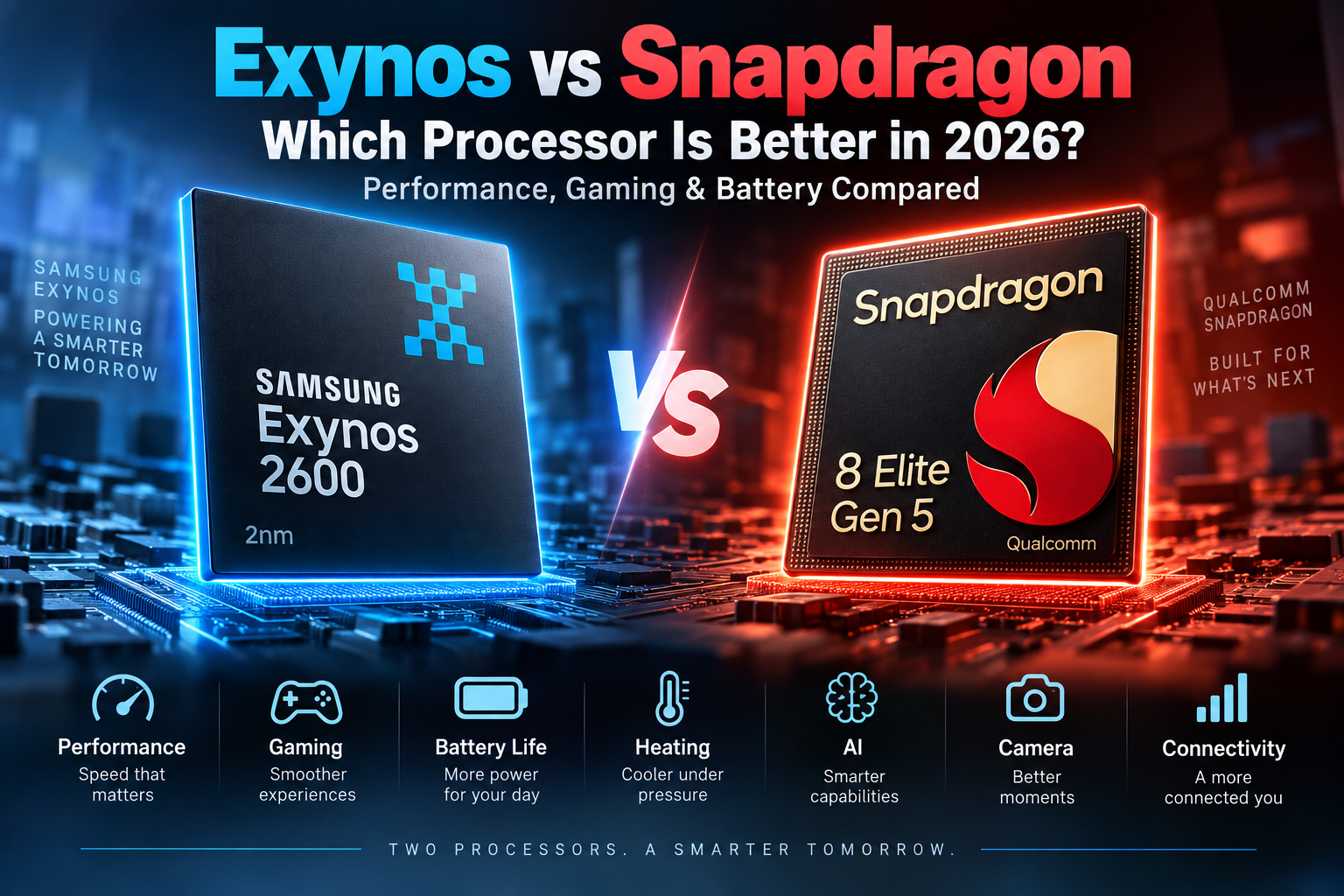
When buying a new Android smartphone, one specification often creates more debate than almost any other: the processor.
Two names frequently appear in flagship Samsung phones and other Android devices — Samsung Exynos and Qualcomm Snapdragon. For years, smartphone buyers have asked the same question: Exynos vs Snapdragon, which is better?
The answer is no longer as simple as saying that one is always faster.
Modern Exynos processors have become considerably more capable, particularly in areas such as artificial intelligence, ray tracing and sustained workloads. Snapdragon chips, meanwhile, continue to have a strong reputation for peak CPU and GPU performance, gaming optimization and broad developer support.
In 2026, the comparison is particularly interesting because Samsung has introduced the Exynos 2600, while flagship Snapdragon-powered phones use the Snapdragon 8 Elite Gen 5. Samsung’s Exynos 2600 is built using a 2nm GAA process and features a 10-core CPU, Xclipse 960 GPU and upgraded NPU.
So, is Snapdragon still better than Exynos? Or has Samsung finally closed the gap?
Let’s take a detailed look at Exynos vs Snapdragon performance, gaming, battery life, heating, AI capabilities and real-world usage.
Exynos vs Snapdragon: What’s the Difference?
Before comparing performance, it helps to understand what Exynos and Snapdragon actually are.
Exynos is Samsung’s family of mobile processors, developed by Samsung Semiconductor. These chips are designed to power smartphones and other mobile devices and integrate components such as the CPU, GPU, NPU, image processor and connectivity technologies.
Snapdragon is Qualcomm’s mobile platform family. Snapdragon processors are widely used across Android smartphones, ranging from affordable devices to premium flagship phones.
Both are examples of system-on-chip (SoC) designs. Instead of having completely separate processors for every task, a modern smartphone SoC combines multiple computing components into a single package.
A modern flagship chip may include:
- CPU for general processing
- GPU for graphics and gaming
- NPU for artificial intelligence
- ISP for camera processing
- Modem for cellular connectivity
- Security hardware
- Memory and storage interfaces
- Power-management technologies
This means that comparing Exynos and Snapdragon based only on CPU clock speed is not enough.
The overall smartphone experience depends on the entire platform, including software optimization, cooling, battery capacity and how individual applications use the hardware.
Exynos vs Snapdragon Performance
Performance is usually the first thing people consider when comparing these processors.
For years, Snapdragon versions of Samsung’s flagship phones have often been regarded as the faster option, especially for demanding workloads. However, the gap has become much smaller in several areas.
The current Exynos 2600 uses Arm’s C1-Ultra and C1-Pro CPU architecture and a 10-core configuration. Samsung says its architecture is designed to improve both computing performance and efficiency.
The Snapdragon 8 Elite Gen 5, meanwhile, uses Qualcomm’s custom Oryon CPU architecture.
Single-core performance
Single-core performance matters for tasks where a small number of CPU cores are heavily utilized.
Examples include:
- Opening applications
- Some browser operations
- Certain games
- App responsiveness
- Emulation
- Some productivity workloads
Recent testing of the Exynos 2600 and Snapdragon 8 Elite Gen 5 found a noticeable Snapdragon advantage in single-core performance. One benchmark comparison measured Snapdragon around 16% ahead in Geekbench 6 single-core performance.
This is one area where Snapdragon maintains a meaningful advantage.
Multi-core performance
Multi-core performance is more complicated.
When many CPU cores are used simultaneously, the Exynos 2600 can be surprisingly competitive. Testing found the difference between the two processors in Geekbench 6 multi-core performance to be extremely small in that particular comparison.
That means everyday multitasking doesn’t necessarily produce a dramatic difference between the two.
If you’re:
- Switching between multiple applications
- Editing documents
- Browsing with many tabs
- Using social media
- Streaming video
- Running AI features
- Performing ordinary productivity tasks
you may not notice a major difference between a well-optimized Exynos phone and a Snapdragon phone.
Performance winner
Winner: Snapdragon for peak performance
Snapdragon currently has the advantage in certain demanding CPU workloads, particularly single-core performance. But Exynos is much more competitive than its reputation might suggest.
Exynos vs Snapdragon for Gaming
Gaming is where the comparison becomes especially interesting.
A smartphone’s gaming performance isn’t determined by the CPU alone. The GPU, thermal system, drivers, game optimization and software configuration can all affect the final experience.
The Exynos 2600 uses Samsung’s Xclipse 960 GPU, while Snapdragon flagship processors use Qualcomm’s Adreno graphics technology.
Samsung says the Xclipse 960 provides substantially higher graphics performance than its predecessor and supports improved ray tracing as well as Exynos Neural Super Sampling (ENSS).
On paper, this makes Exynos much more competitive.
But benchmark performance and actual gaming aren’t always the same.
Snapdragon vs Exynos: GPU Performance
Recent testing found that Snapdragon maintained a significant advantage in conventional 3DMark Wild Life Extreme graphics performance, with the Snapdragon 8 Elite Gen 5 scoring about 25% higher in that particular test.
However, the picture changed during longer stress testing.
The Exynos 2600 demonstrated strong sustained performance in some workloads, and its behavior in ray-tracing testing was much more competitive. In one Solar Bay stress test, the Exynos chip performed roughly on par with Snapdragon and showed strong sustained behavior.
This illustrates an important point:
The fastest benchmark result doesn’t always mean the best long-term gaming experience.
A phone that starts extremely fast but becomes hot and throttles heavily may eventually deliver lower frame rates than a device that maintains a slightly lower but more consistent level of performance.
Real-World Gaming: Exynos vs Snapdragon
For serious mobile gamers, there is another factor that is sometimes overlooked: game optimization.
Developers don’t necessarily provide identical settings and frame-rate options for every chipset.
Recent real-world testing of the Exynos 2600 found that some games limited the chip to 60fps even though the hardware appeared capable of higher performance. Other games allowed it to approach 120fps.
This means two phones with theoretically powerful GPUs can provide different gaming experiences depending on how the game recognizes and supports the hardware.
For example, a game may have:
- Different graphics presets
- Different maximum frame rates
- Different driver optimizations
- Different thermal profiles
- Different GPU compatibility settings
This is one reason Snapdragon continues to be attractive to dedicated gamers.
Gaming winner
Winner: Snapdragon
For maximum gaming performance, broader optimization and more consistent peak frame rates, Snapdragon remains the safer choice.
However, the Exynos 2600 is not a weak gaming processor. It is capable of delivering excellent gaming performance, especially when the game is properly optimized for it.
Exynos vs Snapdragon Battery Life
Battery life is more complicated than simply asking which processor is more efficient.
A smartphone’s battery endurance depends on:
- Processor efficiency
- Display resolution
- Display refresh rate
- Modem efficiency
- Battery capacity
- Software
- Background applications
- Signal strength
- Camera usage
- Gaming
- Cooling system
Therefore, the same processor can deliver different battery results in different smartphones.
Is Snapdragon More Battery Efficient?
Historically, Snapdragon has often been praised for power efficiency, particularly in flagship devices.
Recent Galaxy S26 testing provides an interesting example. In one battery comparison, a Snapdragon-powered Galaxy S26 lasted significantly longer than the Exynos version under a mixed workload, although battery testing methodology and device configuration can affect results.
This shouldn’t be interpreted as proof that every Snapdragon phone will automatically have better battery life than every Exynos phone.
The phone itself matters enormously.
Samsung has also focused heavily on efficiency with the Exynos 2600. The chip is manufactured using a 2nm GAA process, and Samsung specifically highlights power-efficiency improvements in its design.
Battery winner
Winner: Snapdragon, with an important caveat
Snapdragon currently has a stronger real-world track record in many flagship comparisons, but battery life should always be evaluated at the phone level rather than solely by processor name.
Exynos vs Snapdragon Heating
Heat is another important part of the Exynos vs Snapdragon debate.
When a processor is under heavy load, it produces heat. If temperatures rise too much, the phone may reduce CPU and GPU performance to protect the hardware and control temperatures.
This process is commonly called thermal throttling.
A phone’s thermal performance depends on:
- Processor architecture
- Manufacturing process
- Cooling system
- Vapor chamber design
- Phone thickness
- Ambient temperature
- Software tuning
- Workload
Therefore, it isn’t accurate to say that one processor will always run hotter in every phone.
However, recent Exynos 2600 gaming tests showed that some demanding workloads could cause the Galaxy S26 Plus to warm up relatively quickly, followed by a reduction in gaming performance during prolonged sessions.
At the same time, stress testing also showed that Exynos can maintain competitive performance in some prolonged workloads.
This demonstrates why short benchmark tests aren’t enough.
Heating winner
Winner: Snapdragon for demanding sustained gaming
But the cooling hardware of the smartphone remains extremely important.
A well-cooled Exynos phone can outperform a poorly cooled Snapdragon phone in sustained workloads.
Exynos vs Snapdragon for AI
Artificial intelligence has become an increasingly important part of smartphone processors.
Modern phones use dedicated AI hardware for tasks such as:
- Generative AI
- Photo editing
- Voice recognition
- Translation
- Image processing
- Object recognition
- AI assistants
- On-device language models
The Exynos 2600 puts significant emphasis on AI.
Samsung says its latest Exynos chip includes a redesigned NPU and provides a 113% improvement in generative AI performance compared with the Exynos 2500 under Samsung’s internal testing methodology.
It also supports technologies designed to improve on-device AI processing efficiency.
This makes AI one of the areas where modern Exynos chips should not be dismissed simply because Snapdragon may lead in traditional benchmarks.
AI winner
Result: Too close to declare a universal winner
The better choice depends on the specific AI workload, software implementation and application support.
Exynos vs Snapdragon for Camera Performance
The processor also plays an important role in smartphone photography.
The image signal processor, or ISP, handles much of the computational work involved in processing photos and videos.
The SoC can influence:
- HDR processing
- Night photography
- Noise reduction
- Video stabilization
- Computational photography
- AI image enhancement
- Video encoding
The Exynos 2600 includes Samsung’s upgraded image-processing technologies, including an AI-based Visual Perception System and Deep Learning Video Noise Reduction. Samsung also lists support for cameras up to 320MP under its specifications.
However, processor capability doesn’t automatically determine camera quality.
The camera sensor, lens, software and image-processing algorithms are equally important.
A Snapdragon phone with better camera hardware can easily outperform an Exynos phone with a weaker camera system.
Camera winner
Result: Depends on the smartphone
Don’t choose a phone based only on whether it has Exynos or Snapdragon if photography is your priority.
Exynos 2600 vs Snapdragon 8 Elite Gen 5
This is currently one of the most interesting direct comparisons in the Android flagship market.
| Category | Exynos 2600 | Snapdragon 8 Elite Gen 5 |
|---|---|---|
| CPU | Very strong | Excellent |
| Single-core performance | Strong | Faster |
| Multi-core performance | Highly competitive | Excellent |
| GPU | Xclipse 960 | Adreno |
| Traditional graphics | Strong | Faster |
| Ray tracing | Very competitive | Excellent |
| Sustained workloads | Strong | Strong |
| Gaming optimization | Good | Generally better |
| AI | Major improvement | Excellent |
| Efficiency | Strong | Very competitive |
| Overall gaming | Very good | Better |
The Exynos 2600 is manufactured using Samsung’s 2nm GAA process, while the Snapdragon 8 Elite Gen 5 uses TSMC’s 3nm N3P process according to comparative testing.
The important takeaway is that Exynos has become much more competitive, but Snapdragon still has an advantage when the goal is maximum peak performance.
Which Is Better for Everyday Use?
For normal smartphone activities, the difference between Exynos and Snapdragon can be much smaller than benchmark charts suggest.
For example, both can handle:
- YouTube
- Chrome
- Video streaming
- Navigation
- Photography
- Multitasking
- AI features
- Office applications
with excellent performance.
If you’re an average smartphone user, choosing between the two shouldn’t be based exclusively on benchmark numbers.
Other factors may matter more:
- Display quality
- Camera system
- Battery capacity
- Software support
- Storage
- Price
- Build quality
- Charging speed
Everyday-use winner
Result: Tie for most users
Both are powerful enough for demanding everyday smartphone usage.
Which Is Better for Gaming?
If gaming is your top priority, the answer becomes clearer.
Snapdragon is generally the better choice for serious mobile gaming.
Why?
Snapdragon’s advantages can include:
- Strong peak GPU performance
- Broad game optimization
- Consistent frame rates
- Strong emulator performance
- Mature graphics drivers
- Better access to high-frame-rate modes in some games
Recent testing found that Exynos 2600 can be highly capable in real games, but game-specific limitations and thermal behavior can reduce its potential in certain titles.
For casual gaming, however, Exynos is more than capable.
Which Is Better for Battery Life?
There isn’t a universal answer.
If you’re comparing two phones with similar hardware and software, Snapdragon may have an advantage in some scenarios.
But battery life depends heavily on the complete device.
For example, a phone with:
- A larger battery
- A more efficient display
- Better cooling
- Optimized software
could deliver better endurance even if it uses a different processor.
Therefore, compare actual phone battery tests rather than assuming Snapdragon always wins.
Which Is Better for Performance?
For pure peak performance:
Snapdragon wins.
For everyday performance:
The difference is much smaller.
For sustained workloads:
The result can vary depending on cooling and software.
The latest Exynos 2600 demonstrates that Samsung has made significant progress. Its multi-core performance can be highly competitive, while its graphics architecture has also improved substantially.
Is Exynos Still Worse Than Snapdragon?
The short answer is no.
The idea that every Exynos processor is automatically inferior to every Snapdragon chip is outdated.
There have certainly been generations where Snapdragon held a substantial advantage, but the modern Exynos lineup is much more competitive.
The Exynos 2600 is a good example.
Samsung has invested in:
- 2nm manufacturing
- New CPU architecture
- Xclipse graphics
- Ray tracing
- Neural Super Sampling
- AI acceleration
- Improved power management
- Advanced image processing
These improvements don’t necessarily make Exynos the overall winner, but they demonstrate that Samsung’s chip division remains highly competitive.
Why Do Samsung Phones Sometimes Have Exynos and Snapdragon Versions?
One of the biggest reasons consumers encounter this debate is Samsung’s regional chipset strategy.
Samsung has historically sold different versions of certain Galaxy flagship phones in different markets.
This can mean that two customers buying what appears to be the same Galaxy model may receive phones with different processors.
There can be differences in:
- CPU performance
- GPU performance
- Modem behavior
- Battery life
- Heat
- Gaming
- Benchmark scores
Samsung’s 2026 reporting confirms that the Galaxy S26 family uses Snapdragon 8 Elite Gen 5 and Exynos 2600 platforms depending on model and market.
For buyers, this makes checking the exact regional model number and processor worthwhile before purchasing.
Should You Buy Exynos or Snapdragon?
The answer depends on what you want from your phone.
Choose Snapdragon if you:
- Want maximum gaming performance
- Care about peak benchmark scores
- Use demanding emulators
- Want strong game optimization
- Play high-frame-rate games
- Want consistent performance under heavy workloads
Choose Exynos if you:
- Want a modern flagship Samsung experience
- Don’t play extremely demanding games
- Value on-device AI features
- Want excellent everyday performance
- Find the Exynos model significantly cheaper
- Prefer the overall phone rather than focusing solely on the processor
For most normal users, an Exynos-powered flagship isn’t something to avoid automatically.
Exynos vs Snapdragon: Final Verdict
So, Exynos vs Snapdragon — which is better?
There is no single answer for every smartphone user.
If we focus strictly on peak performance and demanding gaming, Snapdragon remains the safer winner. Recent testing continues to show advantages in single-core CPU performance and conventional GPU workloads, while game optimization also favors Snapdragon in several scenarios.
However, modern Exynos processors are no longer the obvious underdogs they were once considered to be.
The Exynos 2600 is a particularly important step forward. Its 2nm manufacturing process, upgraded CPU, Xclipse 960 GPU, improved AI capabilities and ray-tracing performance make it a serious flagship platform.
For everyday smartphone use, the difference between Exynos and Snapdragon may be difficult to notice.
Our overall conclusion:
Best for peak performance: Snapdragon
Best for demanding gaming: Snapdragon
Best for everyday use: Tie
Best sustained performance: Depends on device and cooling
Best AI experience: Too close to call universally
Best overall for most users: Depends on the phone, price and software
Ultimately, Snapdragon is still the safer choice for enthusiasts and serious gamers, while Exynos has become a much more capable alternative for everyday flagship smartphone users.
The most important thing is not to buy a phone simply because it says “Snapdragon” or “Exynos” on the specification sheet. Look at the complete device — including its cooling system, battery, camera, display, software and price.
Frequently Asked Questions
Is Snapdragon better than Exynos?
For peak performance and demanding gaming, Snapdragon generally has the advantage. However, modern Exynos processors are highly capable and can deliver excellent everyday performance.
Is Exynos good for gaming?
Yes. Modern Exynos processors can provide excellent gaming performance. However, Snapdragon may offer better peak performance, game optimization and sustained results in some demanding titles.
Which is better, Exynos 2600 or Snapdragon 8 Elite Gen 5?
The Snapdragon 8 Elite Gen 5 is generally stronger for peak CPU and traditional GPU performance, while the Exynos 2600 is highly competitive in multi-core workloads, ray tracing and some sustained tests.
Does Exynos heat more than Snapdragon?
It depends on the smartphone and workload. Recent gaming tests have shown the Exynos 2600 can heat up relatively quickly during demanding gaming workloads, but thermal performance is also heavily influenced by the phone’s cooling system and software.
Which has better battery life, Exynos or Snapdragon?
There is no universal winner. Battery life depends on the processor, display, battery capacity, modem, software and device design. Some recent Galaxy S26 testing showed an advantage for the Snapdragon version, but individual results can vary.
Is Exynos 2600 a good processor?
Yes. The Exynos 2600 is a modern flagship processor with a 2nm GAA manufacturing process, 10-core CPU, Xclipse 960 GPU and significant AI improvements.
Which processor should I choose for a Samsung phone?
If gaming and maximum performance are your highest priorities, Snapdragon is generally the safer choice. If you care more about the overall phone experience, an Exynos-powered Samsung phone can still be an excellent option.
Conclusion
The Exynos vs Snapdragon debate has changed considerably.
Snapdragon still leads in several areas that matter to enthusiasts, particularly peak CPU performance, conventional GPU performance and gaming optimization. But Samsung’s latest Exynos 2600 shows that Exynos is becoming increasingly competitive.
Instead of asking whether Exynos is simply “bad” and Snapdragon is “good,” a better question is:
Which processor is better for your specific usage?
For gamers and performance enthusiasts, Snapdragon remains the stronger recommendation.
For everyday users, modern Exynos hardware is powerful enough to deliver a premium smartphone experience.
And as Samsung continues improving its semiconductor technology, the gap between Exynos and Snapdragon could become even more interesting in future flagship generations.