
After years of relentless rumors and patent leaks, Apple has officially unveiled the first foldable smartphone in the company’s history: the Duo. Marking Apple’s long-awaited debut in the flexible display arena, the device aims to redefine usability with an ultra-thin form factor. While Apple positions the launch as the perfection of foldable design, its primary rival, Samsung, wasted no time poking fun at Apple’s seven-year delay.
Design and Display: A Passport-Sized, Record-Breaking Profile
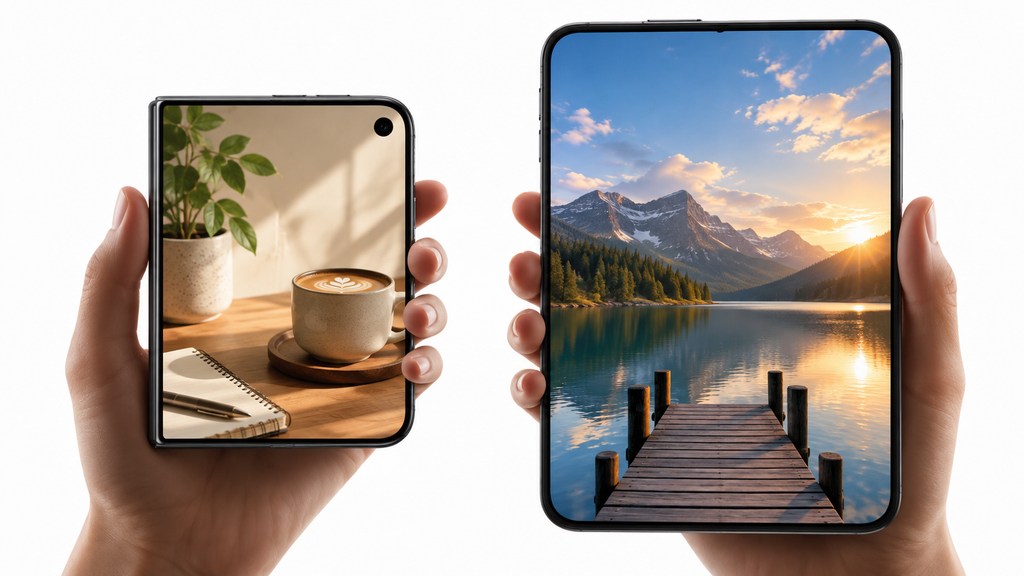
Rather than following the elongated form factor common in modern smartphones, Apple designed the Duo around practical, pocket-friendly ergonomics:
- Passport Form Factor: When closed, the Duo mirrors the proportions of a standard passport, complete with gently curved edges for a natural one-handed grip.
- 7.6-Inch Inner Canvas: Unfolded, the main display expands to a generous 7.6 inches, fully optimized for seamless operation in both vertical (portrait) and horizontal (landscape) modes.
- Cover Screen: A streamlined outer display handles notifications, calls, and quick tasks when the phone remains shut.
- Apple’s Thinnest Phone Yet: Engineering advancements make the Duo the thinnest smartphone Apple has produced, targeting the bulkiness that often plagues folding hardware.
Speaking at the Steve Jobs Theater in Cupertino, Apple executive John Ternus highlighted this familiar feel, emphasizing that the device sits naturally in the hand without the awkwardness typical of large foldables.
Under the Hood: Next-Gen A20 Silicon and the In-House C2 Modem
The Duo serves as a showcase for Apple’s latest custom silicon, bringing desktop-class performance to a dual-screen format:
- A20 Chipset: Powers the dual-display architecture, high-refresh rates, and intensive multitasking without thermal throttling.
- Proprietary C2 Modem: In a critical step toward reducing reliance on Qualcomm for wireless connectivity, the Duo integrates Apple’s newly developed C2 modem chip.
- 48MP Fusion Ultra-Wide Camera: Borrowing high-end camera tech from the flagship Pro lineup, the Duo features a 48-megapixel primary camera system built for flagship-grade low-light performance and color accuracy.
Pricing and Release Date
Positioned squarely in the ultra-premium luxury tier, the device comes with a top-bracket price tag:
- Retail Price: $1,999 USD
- Official Availability: The Duo hits store shelves and carrier partners starting October 23.
The Rivalry Ignites: Samsung’s Sharp Jab
Samsung pioneered the commercial foldable category with the original Galaxy Fold in 2019, and the South Korean tech giant immediately seized on Apple’s late arrival.
Taking to social media, Samsung mocked the seven-year wait:
“Making us wait? Fine, we’ll be over here, folding things in three.”
Samsung also mocked the name “Duo,” tagging the language-learning platform Duolingo on X with a tongue-in-cheek post: “I’m sorry, Duolingo. They copied our stuff too.”
Apple took its own pre-emptive swing during the launch video. Ternus pointedly noted that while other manufacturers have produced foldable devices, competitors’ designs often feel like “two phones uncomfortably stuck together.”
The Global Foldable Race: Xiaomi and Huawei Raise the Stakes
Apple’s entry comes amid aggressive moves from Chinese rivals who are already advancing past single-hinge devices:
- Xiaomi: The world’s third-largest smartphone manufacturer recently introduced its cutting-edge Xiaomi 18 Fold.
- Huawei: Expanding on multi-fold innovation, Huawei debuted the Mate XT 2, representing the third generation of its tri-fold (three-layer folding) smartphone lineup.
Apple’s entry marks the maturation of the foldable category. With a $1,999 price tag, proprietary C2 connectivity, and an ultra-thin passport footprint, the Duo faces tough competition from multi-fold Android flagships, but it finally gives iOS loyalists the flexible screen they have spent years waiting for.